
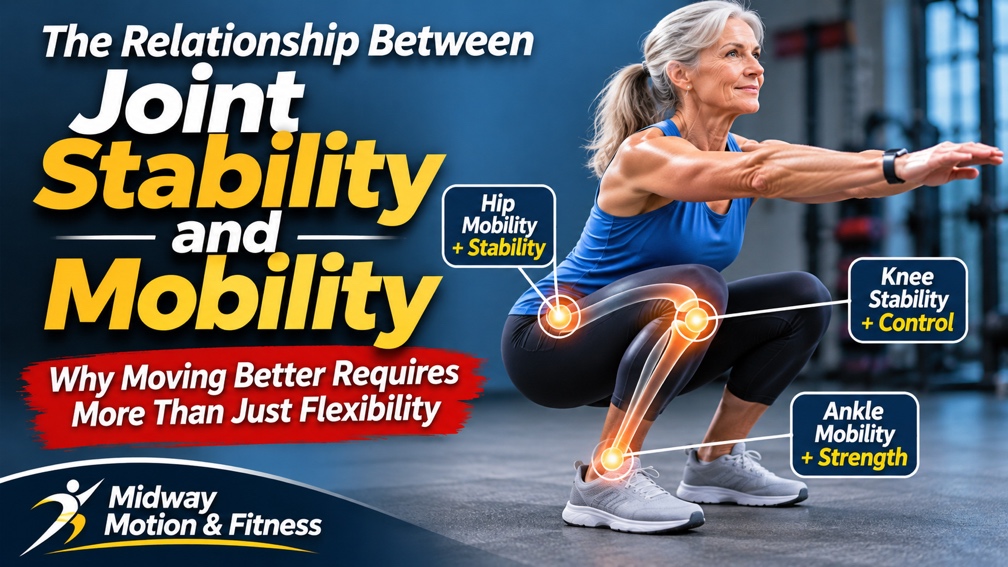
Why Moving Better Requires More Than Just Flexibility
When we think about improving movement, most people immediately think about stretching. Tight hips? Stretch them. Stiff shoulders? Stretch them. Limited ankle movement? Stretch some more.
But what if the problem isn't simply a lack of flexibility?
What if your body needs more stability, strength, and control before it can move efficiently?
This is where understanding the relationship between joint mobility and joint stability becomes important.
Mobility vs. Stability: What's the Difference?
Mobility is your ability to move a joint through its available range of motion with control.
Stability is your ability to control joint position and movement while resisting unwanted forces.
Think of mobility as your ability to move and stability as your ability to control that movement.
Both are essential. Having excellent mobility without sufficient stability can make it difficult to control your joints, especially during activities requiring strength, balance, or rapid movement.
On the other hand, having strength and stability without adequate mobility can restrict movement and lead to compensations elsewhere in the body.
The goal isn't simply to move more. It's to move better.
Your Body Works as a Connected System
Our joints don't function independently. They work together as part of a coordinated movement system.
For example, consider a simple squat.
Your ankles need sufficient mobility to allow your knees to move forward. Your hips need mobility to descend comfortably. Meanwhile, your knees, hips, and trunk must provide enough muscular control to maintain proper alignment throughout the movement.
If your ankles lack mobility, your body may compensate by lifting your heels, changing your trunk position, or altering the way your knees and hips move.
Similarly, if your hips lack sufficient strength and stability, you may struggle to control your knees during the squat.
The result isn't necessarily an immediate injury, but repeated compensations can increase stress on certain tissues and reduce movement efficiency.
Why Stability Can Influence Mobility
Here's something many people overlook: sometimes a joint has adequate passive range of motion but struggles to access or control that range actively.
For example, you may be able to lift your leg higher when someone assists you than when you lift it yourself.
This difference can reflect limitations in strength, motor control, or coordination rather than simply shortened muscles.
The nervous system plays an important role in coordinating muscle activation and joint movement. Pain, previous injuries, and a lack of confidence in a movement can also influence how freely someone moves.
This is why strengthening muscles throughout a joint's available range of motion can sometimes improve functional mobility more effectively than stretching alone.
The Ankle: A Perfect Example
Your ankle is one of the most important joints for walking, running, squatting, and maintaining balance.
It needs enough mobility to allow the shin to move forward over the foot. It also needs muscular stability to control the foot and ankle when your body contacts the ground.
Imagine stepping off a curb.
Your foot and ankle must absorb the landing forces while your muscles help control the movement. Your knees and hips then work together to manage those forces throughout the lower body.
If ankle mobility is restricted, your body may compensate through altered movement at the knee, hip, or trunk.
If ankle stability and strength are insufficient, controlling the landing may become more difficult.
This demonstrates why mobility creates movement possibilities, while stability helps you control those possibilities.
Strength Training Is Also Mobility Training
Many people separate strength training and mobility training as though they are completely different.
But properly designed resistance training can develop both.
Consider exercises such as:
- Deep squats: Improve strength and control through the available range of hip, knee, and ankle movement.
- Split squats: Challenge hip mobility, single-leg strength, and pelvic stability.
- Single-leg balance exercises: Improve neuromuscular coordination and joint control.
- Controlled lunges: Strengthen muscles while challenging movement through multiple joints.
- Resistance band exercises: Challenge stability and muscular control in different directions.
Training through an appropriate, comfortable range of motion can improve both strength and active mobility.
Why This Becomes More Important as We Age
As we get older, changes in muscle strength, physical activity, coordination, and joint health can affect how we move.
Some people become less mobile because they spend too much time sitting or rarely move their joints through larger ranges of motion.
Others may maintain flexibility but lose the strength and coordination needed to control their movements.
This combination can affect walking, climbing stairs, reaching overhead, and recovering balance when we stumble.
That's why a complete fitness program should include mobility exercises, strength training, balance work, and controlled movement.
The objective isn't to become exceptionally flexible.
It's to maintain the physical ability to move confidently and independently throughout life.
The Bottom Line: Mobility and Stability Work Together
Mobility without stability can leave movement poorly controlled.
Stability without adequate mobility can limit movement options.
But when you develop both, you create a stronger foundation for efficient movement, better balance, and long-term physical function.
The next time you feel stiff or restricted, remember that stretching may be only part of the solution.
Your body may also benefit from strength, coordination, and better control throughout your available range of motion.
Don't just train your body to move farther. Train it to move stronger, with greater control and confidence.
Midway Motion & Fitness — Helping You Move Better, Get Stronger, and Stay Active for Life.
Jason Kelly