
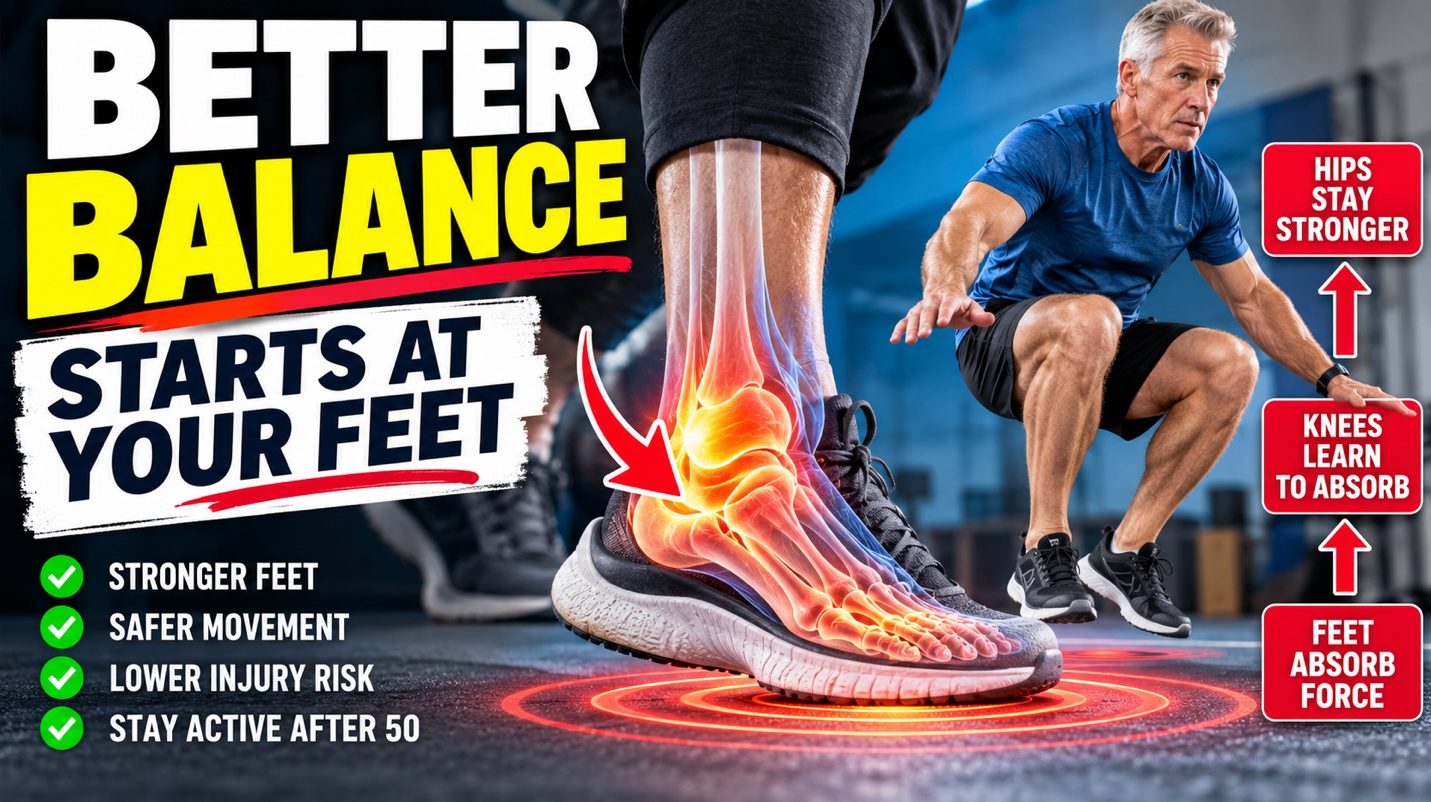
Why Strong Feet and Ankles Matter More as We Age
When most people think about improving their balance, they imagine standing on one leg or holding a position without falling over. But there's much more to balance than simply standing still.
Better balance starts from the ground up — with your feet and ankles.
Every time you stand, walk, turn, or step onto an uneven surface, your feet and ankles are constantly gathering information about your body's position. This information travels to your brain, helping your muscles make the small adjustments needed to keep you stable.
Your Feet Are Your Body's Balance Sensors
Your feet contain thousands of sensory receptors that help detect pressure, movement, and changes in position.
This process is part of what we call proprioception — your body's ability to sense where it is in space.
Think about walking across grass, stepping off a curb, or moving across an uneven sidewalk. Your feet and ankles help detect those changes, while your nervous system coordinates the muscles needed to maintain balance.
As we age, changes in sensation, muscle strength, reaction time, and coordination can make these adjustments more difficult.
Your Feet Are Your First Line of Defense
Think about something simple, like walking. What's the first part of your body to make contact with the ground?
Your foot.
Every time your foot contacts the ground, it must help absorb and manage the forces created by your body weight and movement.
Now think about jumping.
When you jump and land, your feet are the first part of your body to contact the ground. That landing creates forces that must be absorbed and controlled throughout your lower body.
Your feet and ankles begin responding immediately, while your knees and hips work together to help absorb the impact.
The greater the landing force, the greater the demand on your muscles and joints to control it.
If your feet and ankles lack sufficient strength, mobility, or stability, your body may have difficulty managing those forces efficiently. This can change how your knees and hips respond and potentially increase the risk of injury.
But here's what's important: you don't have to jump to experience these forces.
Every time you walk, climb stairs, step off a curb, or change direction, your body must absorb and redistribute forces through your lower extremities. The magnitude of those forces changes depending on your speed, body weight, movement technique, and the activity itself.
That's why strengthening your feet and ankles is about much more than simply improving balance.
It's about developing the ability to absorb force, control movement, and transfer that force efficiently throughout your body.
Why Strong Legs Alone Aren't Enough
You can have strong quadriceps, hamstrings, and glutes and still struggle with balance.
That's because balance isn't just about muscular strength. It's also about how quickly and accurately your nervous system detects movement and responds.
Your feet and ankles play an important role in controlling small shifts in body position. Your knees and hips help provide additional strength and stability, particularly when larger movements are required.
Good balance depends on the entire lower body working together.
Train Your Balance From the Ground Up
One of my favorite ways to train balance is with resistance bands.
By applying resistance at different points along the lower body, we can challenge the muscles and nervous system in ways that resemble everyday movement.
Here are three areas I like to focus on:
1. Foot and Ankle Stability
Using a resistance band positioned just above the knee, we can create a controlled pulling force that challenges the foot and ankle to maintain stability.
This encourages the body to make small corrective adjustments while maintaining proper alignment.
2. Knee Stability and Control
By changing the direction of resistance, we can challenge the quadriceps and hamstrings to work together to control the knee.
This helps develop strength and coordination during movements such as walking, climbing stairs, and changing direction.
3. Hip Strength and Stability
Moving the resistance band to the hips allows us to perform controlled stepping and lunging movements that engage the glutes and challenge hip stability.
Strong hips are especially important when we need to make larger adjustments or quickly regain our balance.
For safety, these exercises should be adjusted to individual ability, with a stable support available when needed.
The Real Goal: Staying Strong, Stable, and Independent
Balance training isn't just about preventing falls. It's about maintaining the confidence and physical ability to enjoy everyday life.
Whether you're playing pickleball, walking on the beach, climbing stairs, or simply moving around your home, good balance makes movement easier and more controlled.
And while your feet and ankles are an important starting point, lasting improvements come from training the entire balance system — including strength, coordination, vision, and reaction time.
Remember: Better balance starts at your feet, but it takes your whole body to keep you moving.
Stay strong. Stay active. Keep moving.
Jason Kelly