What if just one workout a week could help you feel less tired and get more out of your day?
As we get older, one of the biggest changes we may notice isn't necessarily a loss of strength. It's a loss of energy and endurance.
Think about it.
Maybe you used to go all day without thinking twice about it. You could work, exercise, run errands, take care of your family, and still have energy left over in the evening.
But now, by two or three in the afternoon, you're starting to slow down. Your legs feel tired, your motivation drops, and you're ready to call it a day.
What if you could change that?
That's where High-Intensity Interval Training (HIIT) comes in.
HIIT is one of the most time-efficient ways to improve cardiovascular fitness, muscular endurance, and overall physical performance, especially for adults over 50.
And one of its greatest benefits isn't necessarily something you see in the mirror.
It's something you feel throughout your entire day: the ability to do more without getting tired as quickly.
What Exactly Is HIIT Training?
HIIT involves alternating short periods of challenging exercise with periods of recovery.
Instead of exercising at the same pace for 30 or 40 minutes, you challenge your heart, lungs, and muscles to work harder for short intervals, followed by periods of reduced intensity or rest.
For example, you might perform 30 seconds of challenging exercise followed by 30–60 seconds of recovery.
The exercises can include squats, step-ups, marching, cycling, resistance exercises, or other functional movements.
The beauty of HIIT is that it can be adjusted to almost any fitness level.
You don't have to be an athlete, jump around, or push yourself to exhaustion to benefit.
The goal is to challenge your body appropriately, allow it to recover, and gradually improve its ability to perform physical work.
The Energy Difference: You May Start Feeling It in Just a Few Weeks
Here's where HIIT gets exciting.
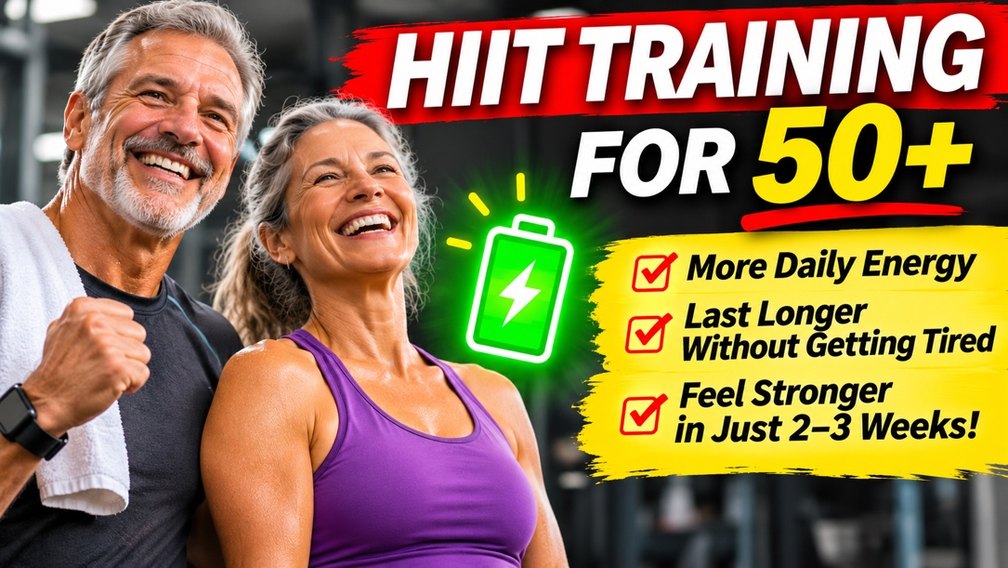
Within two to three weeks of consistent training, some people may begin noticing that everyday activities feel easier and that they're not getting tired as quickly.
We're not talking about the temporary energy boost you get from drinking another cup of coffee.
We're talking about improving your body's ability to sustain physical activity.
Imagine that right now, after five hours of being active, you're exhausted. You start slowing down, your legs feel heavy, and you just want to sit down.
As your cardiovascular fitness and muscular endurance improve, you may find yourself going longer before experiencing that same level of fatigue.
Instead of feeling worn out halfway through your day, you may have the stamina to remain active into the afternoon or evening.
That doesn't mean HIIT will automatically turn five hours of energy into ten. It means your body can become more efficient, allowing you to accomplish the same activities with less physical effort.
You're not creating extra hours in your day. You're improving your ability to enjoy the hours you already have!
And that's one of the most valuable benefits of exercise after 50.
Why Does HIIT Give You Greater Endurance? The Science Behind It
The answer comes down to how your body produces, delivers, and uses energy.
HIIT doesn't simply make you feel more energetic. It stimulates physiological adaptations that improve your body's ability to perform work.
Let's look at five important changes.
1. Mitochondria: Your Body's Energy Factories
Inside your muscle cells are tiny structures called mitochondria.
Think of them as your body's energy-producing factories.
Their primary job is to help convert carbohydrates and fats into ATP (adenosine triphosphate), the energy your muscles need to contract and perform physical activity.
As we age, particularly when we become less active, mitochondrial function and aerobic capacity can decline.
HIIT helps challenge these energy-producing systems.
During intense exercise, your muscles experience an increased demand for ATP. This activates cellular signaling pathways, including AMPK and PGC-1α, that help stimulate mitochondrial adaptations.
With consistent training, your muscles can improve their ability to produce energy aerobically.
You're improving the machinery responsible for producing the energy your muscles use.
2. Your Heart Becomes More Efficient
Your heart is responsible for delivering oxygen-rich blood to your working muscles.
During HIIT, your heart must respond to increased demands for oxygen and circulation.
Over time, regular training can improve cardiovascular function, including the amount of blood your heart pumps with each beat, known as stroke volume.
These adaptations contribute to improvements in VO₂ max, a measure of your body's maximum ability to take in, transport, and use oxygen during intense exercise.
Why is that important?
Because the greater your aerobic capacity, the less demanding everyday activities become relative to your physical abilities.
Imagine climbing a flight of stairs.
Before training, that activity might feel like a 7 out of 10 in difficulty.
After improving your cardiovascular fitness, the same stairs might feel like a 5 out of 10.
You haven't changed the stairs. You've changed your body's ability to handle them.
3. Your Muscles Become Better at Using Oxygen
It's not enough for your heart to deliver oxygen. Your muscles must also be able to use it efficiently.
HIIT can improve the activity of oxidative enzymes within muscle cells and, with sufficient training, support improvements in capillary density.
Capillaries are tiny blood vessels that help deliver oxygen and nutrients to your muscles.
These adaptations improve your muscles' capacity to produce energy through aerobic metabolism.
What does this mean?
Your muscles can perform the same amount of work with less relative effort.
That means you may be able to walk farther, remain standing longer, or perform physical activities without becoming fatigued as quickly.
4. Your Body Gets Better at Managing Lactate
As exercise intensity increases, your body produces and uses more lactate.
Contrary to a common misconception, lactate isn't simply a waste product. It's also an important fuel that your muscles and other tissues can use for energy.
HIIT helps improve your ability to transport and utilize lactate while increasing the intensity of exercise you can sustain.
This contributes to improvements in your lactate threshold.
In simple terms, you can work at a higher intensity before fatigue-related metabolic disturbances begin accumulating rapidly.
What does this mean for everyday activities?
You may be able to walk faster, climb more stairs, carry heavier objects, or perform demanding tasks for longer before needing to stop.
5. Your Body Learns to Recover Faster
One of the most interesting benefits of HIIT is that you're not just training your body to work harder.
You're also training it to recover between challenging efforts.
Each interval places demands on your cardiovascular and muscular systems, followed by a period of recovery.
Over time, your body can become more efficient at restoring energy balance and recovering between bouts of activity.
For example, after climbing a flight of stairs, you might previously have needed several minutes to catch your breath.
With improved fitness, you may recover more quickly and feel ready to continue sooner.
That recovery ability is an important part of maintaining endurance throughout the day.
Why Might You Notice Improvements in Just Two to Three Weeks?
Your body begins responding to exercise much sooner than many people realize.
Some early adaptations involve changes in cellular signaling, exercise tolerance, and the way your cardiovascular and muscular systems respond to repeated activity.
During the first few weeks, you may begin noticing that certain activities feel easier or that you recover more quickly after exercise.
More substantial improvements in aerobic fitness and mitochondrial capacity generally develop over several additional weeks of consistent training.
The important thing to understand is that these changes don't happen overnight, and everyone responds differently.
Someone who has been relatively inactive may notice improvements sooner than someone who already exercises regularly.
And while one weekly HIIT class is an excellent starting point, most research demonstrating substantial cardiovascular and metabolic improvements involves training several times per week.
Why HIIT Is Especially Important After 50
As we age, we can experience gradual declines in aerobic capacity, muscle mass, muscular power, and recovery ability.
But age doesn't mean we have to accept those changes without doing something about them.
HIIT can help:
- Improve cardiovascular endurance: Strengthen your heart and improve oxygen delivery.
- Increase stamina: Help you remain physically active longer before becoming fatigued.
- Improve energy production: Support mitochondrial function and aerobic metabolism.
- Improve metabolic health: Support insulin sensitivity and blood sugar regulation.
- Maintain functional fitness: Especially when HIIT includes resistance and functional movements.
- Improve recovery: Help your body recover more efficiently between physical efforts.
- Support independence: Make walking, climbing stairs, shopping, traveling, and recreational activities easier to manage.
And perhaps most importantly, HIIT can help you maintain the physical capacity to enjoy the activities that make life meaningful.
Can Just One HIIT Class a Week Make a Difference?
Absolutely!
One appropriately designed HIIT class per week can be a valuable starting point, especially for someone who isn't currently performing vigorous cardiovascular exercise.
It provides a challenging training stimulus and an opportunity to gradually improve physical conditioning.
For greater long-term results, combine your weekly HIIT class with other physical activities, such as walking, resistance training, cycling, or swimming.
The key is consistency.
You don't need to train at maximum intensity or compete with anyone else.
A good HIIT program should challenge you relative to your individual fitness level, whether you're 50, 60, 70, or beyond.
If you're new to vigorous exercise or have cardiovascular or other medical limitations, begin with appropriately modified intervals and seek medical guidance when necessary.
Remember, intensity is relative. What's challenging for one person may be completely different for another.
Ready to Feel the Difference? Try a HIIT Class!
If you're over 50 and want to improve your stamina, build endurance, and start feeling stronger throughout your day, come experience Miguel's HIIT class!
Miguel will challenge you, motivate you, and help you work at an intensity appropriate for your fitness level.
Start with just one class a week, stay consistent, and notice how your body responds over the next several weeks.
You may be surprised by how much easier everyday activities begin to feel.
More stamina. Less fatigue. More life.
Your age doesn't have to determine your energy. How you train can make a difference!
Jason Kelly