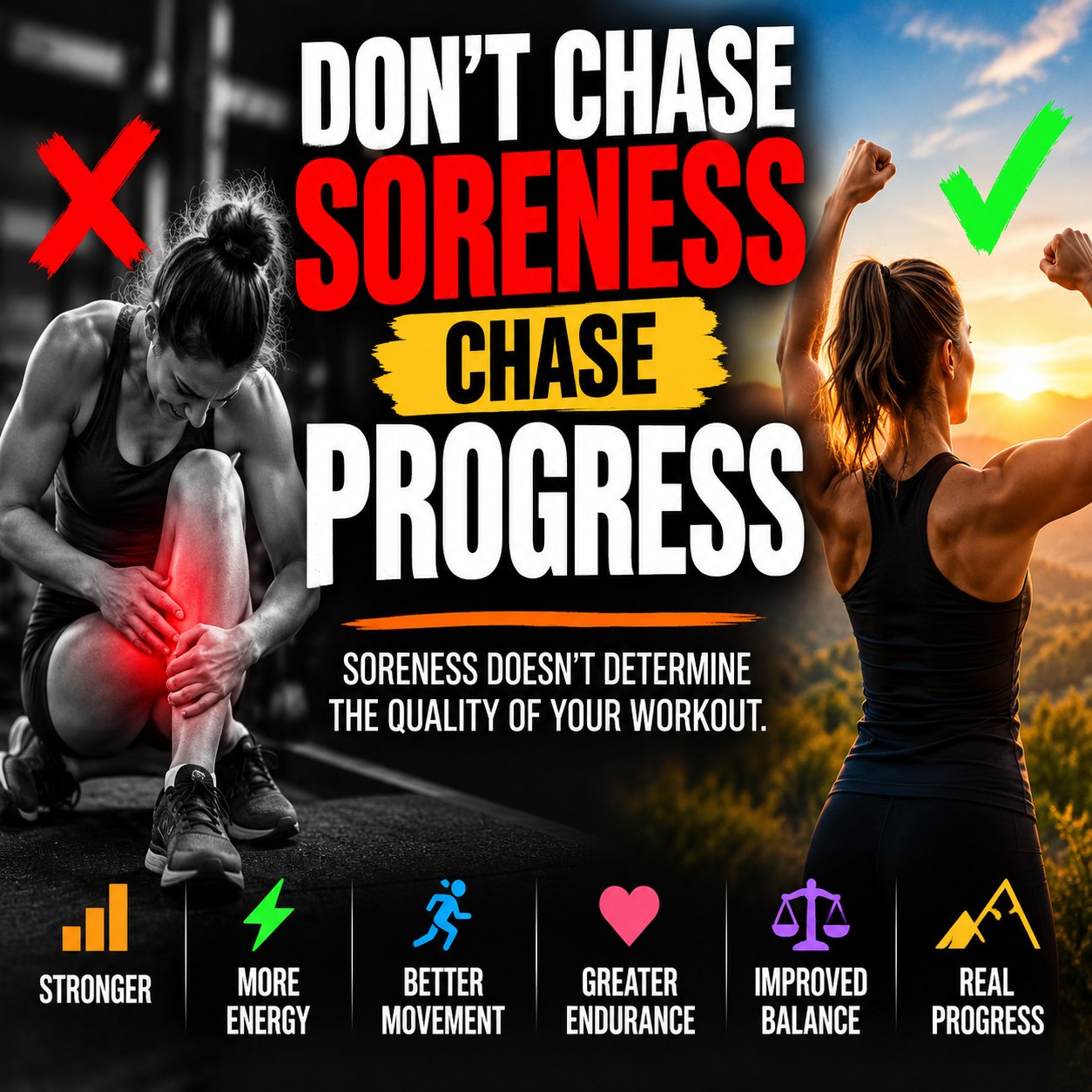
A common fitness belief is that if you're not sore after a workout, you didn't work hard enough.
That simply isn't true.
Muscle soreness—especially delayed onset muscle soreness (DOMS)—can happen after a challenging workout, but it is not a reliable measurement of whether that workout was effective.
The goal of training isn't to make you sore. The goal is to make you better.
Soreness Is a Response, not a Score
You're more likely to get sore when you introduce something your body isn't used to: a new exercise, more volume, a different range of motion, or greater emphasis on eccentric loading.
That soreness tells you your body experienced something unfamiliar or stressful. It doesn't necessarily tell you that you had a better workout.
In fact, as your body adapts to training, you may become less sore while continuing to get stronger, fitter, faster, and more capable.
That's exactly what adaptation is supposed to look like.
If you continually chase soreness, you may actually start adding unnecessary volume or intensity simply because you don't “feel” like you did enough.
More isn't always better.
Better is better.
Pay Attention to How You Feel
Instead of asking, “Am I sore?” after every workout, start paying attention to how your body actually feels and performs.
Do you feel stronger?
Are you moving better?
Do you have more energy?
Are exercises becoming easier?
Are you able to use more resistance or perform more quality repetitions?
Is your balance improving?
Are you recovering well enough to train again?
Can you do things in everyday life that used to be difficult?
Those are much more meaningful signs that your training is working.
You should leave many workouts feeling like you challenged your body—not like you survived something.
There is a difference.
Training Is About Stimulation
Exercise creates a stimulus. Your body responds to that stimulus during recovery.
That response is where improvement happens.
If the training stimulus is appropriate, the body has an opportunity to rebuild and adapt. Over time, that can mean greater strength, better cardiovascular fitness, improved movement, increased power, better balance, and greater physical resilience.
But constantly beating the body into the ground can interfere with that process.
You don't need to destroy the body to convince it to change.
You need to give it the right amount of stress, then allow it to adapt.
This becomes even more important as we get older. Recovery matters. Joint health matters. Energy matters. And consistency matters enormously.
A workout that leaves you unable—or unwilling—to exercise for the next several days isn't automatically superior to one that challenges you appropriately and allows you to come back and train again.
Don't Judge Tomorrow's Workout by Today's Pain
There will certainly be times when you get sore. There's nothing inherently wrong with that.
You may introduce a new exercise and feel it the next day. You may increase your workload. You may train harder than usual. Sometimes soreness simply happens.
But soreness should be viewed as a possible side effect of training, not the objective of training.
And the absence of soreness does not mean nothing happened.
Your muscles don't have to hurt for them to become stronger.
Your heart doesn't have to feel destroyed for your cardiovascular fitness to improve.
Your legs don't have to ache for your balance, speed, or power to get better.
Progress is measured by what your body becomes capable of doing—not by how uncomfortable you can make it feel.
Stimulate, Don't Annihilate
One of the principles I continually come back to is:
Stimulate, don't annihilate.
Give your body enough reason to adapt without constantly giving it more than it can effectively recover from.
Train hard when hard training is appropriate. Challenge yourself. Progress your exercises. Push beyond what your body could previously do.
But understand why you're doing it.
The goal isn't exhaustion.
The goal isn't soreness.
The goal isn't crawling out of the gym.
The goal is improvement.
So, the next morning, instead of using soreness as your report card, ask yourself a better question:
Am I becoming stronger, moving better, feeling better, and becoming more capable because of the way I'm training?
If the answer is yes, your workout is doing exactly what it's supposed to do.
Don't chase soreness. Chase progress.
Jason Kelly