
Why Strength Alone Isn't Enough to Preserve Speed, Power, and Athleticism
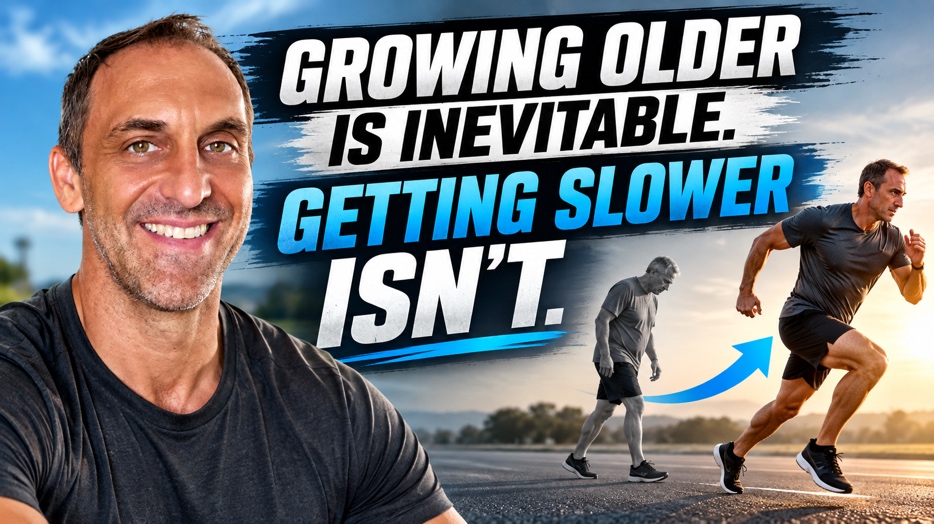
Growing older is inevitable. But does getting older automatically mean we have to slow down, get weaker, and become less athletic?
I don't believe it does.
Yes, our bodies change as we age. We lose muscle mass, our nervous system undergoes changes, and our ability to produce force quickly gradually declines.
But here's a question I think we should be asking:
How much of our physical decline comes from aging itself, and how much comes from simply no longer doing the things we used to do?
Think about it.
When was the last time you sprinted? Jumped as high as you could? Accelerated quickly? Changed direction at speed? For many adults, the answer is years, perhaps even decades.
And somewhere along the way, we begin believing we're simply too old to do those things anymore. But how do you know what you're still capable of if you never try?
Speed Is a Trait and a Skill
Most people understand the importance of strength training. We lift weights to maintain muscle, protect our bones, improve metabolism, and preserve independence. And that's important. But strength is only part of the equation.
Speed is both a physical trait and a neuromuscular skill, and our ability to produce force quickly often declines faster than maximal strength as we age.
You might still be capable of lifting a heavy weight, but can you move your body quickly?
Can you accelerate, react, or change direction? Can you catch yourself if you stumble?
These abilities depend on more than muscular strength. They require your brain, nervous system, and muscles to communicate and coordinate movement rapidly.
And just like strength, these qualities need to be trained.
Strength Is the Foundation. Speed Is How We Express It.
I've spent nearly 30 years working in exercise physiology, strength training, and sports performance.
And today, my personal training philosophy is somewhat different from what many people might expect.
I generally dedicate only a couple of days each week to traditional strength training.
Much of my other training focuses on acceleration, sprinting, jumping, explosiveness, power, and reactive movements.
Why?
Because I've already spent decades developing my strength foundation. I still need to maintain it, but I also want to preserve my ability to use that strength quickly.
Think about someone who can lift a tremendous amount of weight but struggles to move quickly.
Now compare that person with someone who can produce substantial force almost instantly. Both have strength, but they express it differently.
Strength gives us the capacity to produce force.
Speed and power allow us to apply that force rapidly.
As we get older, that distinction becomes increasingly important.
Your Nervous System Needs Training, Too
When people think about exercise, they usually think about muscles. But muscles don't operate independently.
Your nervous system controls muscular activation, coordination, timing, and how rapidly force can be developed. This is why getting stronger doesn't automatically mean getting faster.
Consider the difference between performing a slow squat and executing an explosive jump.
Both require strength, but jumping demands rapid force production, precise timing, and coordination.
The same applies to sprinting, accelerating, or changing direction.
These movements require the nervous system and muscles to work together quickly and efficiently.
As we age, changes in motor-unit function, muscle fibers, and neuromuscular coordination can reduce our ability to produce force rapidly.
And when we stop practicing fast movements, we lose some of the coordination and proficiency needed to perform them.
This helps explain why muscular power, the combination of force and velocity, often declines faster than maximal strength.
But here's the encouraging part:
The nervous system remains adaptable, and speed and power can still improve with appropriate training, even later in life.
We may not regain every ability we had at 20, but that doesn't mean we can't improve what we're capable of doing today.
You Don't Know How Fast You Can Move Until You Try
Here's something I like to tell people:
“You don't know how fast you can still move until you try. And if you never try, you're allowing age to determine your limitations instead of discovering your capabilities.”
I think this is one of the biggest psychological barriers associated with aging.
We begin associating certain movements with youth.
Running fast is for young people. Jumping is for athletes. Explosive movements are for sports.
Older adults should just walk, stretch, and lift light weights.
But who decided that?
I'm certainly not suggesting that someone who hasn't exercised in 20 years should suddenly attempt an all-out sprint. That's not intelligent training.
But there's a big difference between respecting your physical limitations and automatically accepting them as permanent.
If you haven't run in years, begin by walking faster. Progress to controlled acceleration drills.
Introduce quick stepping, marching, skipping, or low-level jumping when appropriate.
Gradually challenge your ability to produce movement more rapidly.
You might be surprised by what your body can still do.
You must challenge yourself to discover how much of it you still have.
And once you discover it, you can begin developing it.
Why I Train for Speed, Power, and Explosiveness
At this stage of my life, I'm not interested in lifting heavier weights simply for the sake of lifting heavier weights.
I still value strength. It's essential for maintaining muscle, bone health, and physical function.
But I also want to preserve the qualities that make movement athletic.
I want to accelerate.
I want to jump.
I want to react quickly.
I want to maintain coordination, explosiveness, and the ability to change direction.
That's why I spend more of my training time developing these qualities while maintaining my strength foundation.
Of course, speed and power training require intelligent programming and recovery. High-intensity sprinting and jumping can place considerable stress on muscles, tendons, and joints.
But training for speed doesn't mean everyone needs to sprint. For some people, it might involve medicine-ball throws, fast step-ups, or quick sit-to-stand movements.
For others, it might involve sprinting, plyometrics, and reactive jumping. The objective is the same: challenge the neuromuscular system to produce force more rapidly, at a level appropriate for the individual.
I don't train just to stay strong. I train to stay fast, powerful, explosive, and reactive.
Don't Just Train to Live Longer. Train to Remain Capable.
Everyone talks about longevity these days.
But I think we should be asking a different question:
What do we want to be physically capable of doing during those additional years?
Do we want to simply live longer?
Or do we want to preserve the strength, speed, coordination, confidence, and independence that allow us to enjoy those years?
For me, the answer is obvious.
I want to preserve as much physical capability as possible.
That means continuing to challenge the qualities that tend to deteriorate with age.
Not just strength, but speed. Not just endurance, but power. Not just mobility, but coordination and reaction. And not just the ability to move, but the confidence to move.
Because physical capability contributes to freedom.
The freedom to enjoy sports, travel, play with your children or grandchildren, and respond to the unexpected physical challenges of everyday life.
Growing Older Is Inevitable. How We Age Is Something We Can Influence.
We cannot stop biological aging.
No exercise program can guarantee we'll retain every physical ability we had in our youth.
But we can influence how we age.
We can maintain strength. We can develop power. We can practice speed. We can improve coordination and reaction. And perhaps most importantly, we can stop assuming that every physical limitation is simply an unavoidable consequence of getting older.
Growing older is inevitable. Becoming slower is common. But how quickly we lose our speed, strength, and power is something we can influence.
So the next time you think you're too old to move quickly, ask yourself one simple question:
When was the last time I actually tried?
You might be surprised by what you're still capable of.
And perhaps even more surprised by what you can become capable of again.
Don't just train for what you can lift. Train for what you can still do.
Jason Kelly
Jason Kelly is an exercise scientist and sports performance coach with nearly 30 years of experience. He is the author of “Stay Young Now” and specializes in helping people preserve strength, movement, speed, power, and physical independence as they age.