
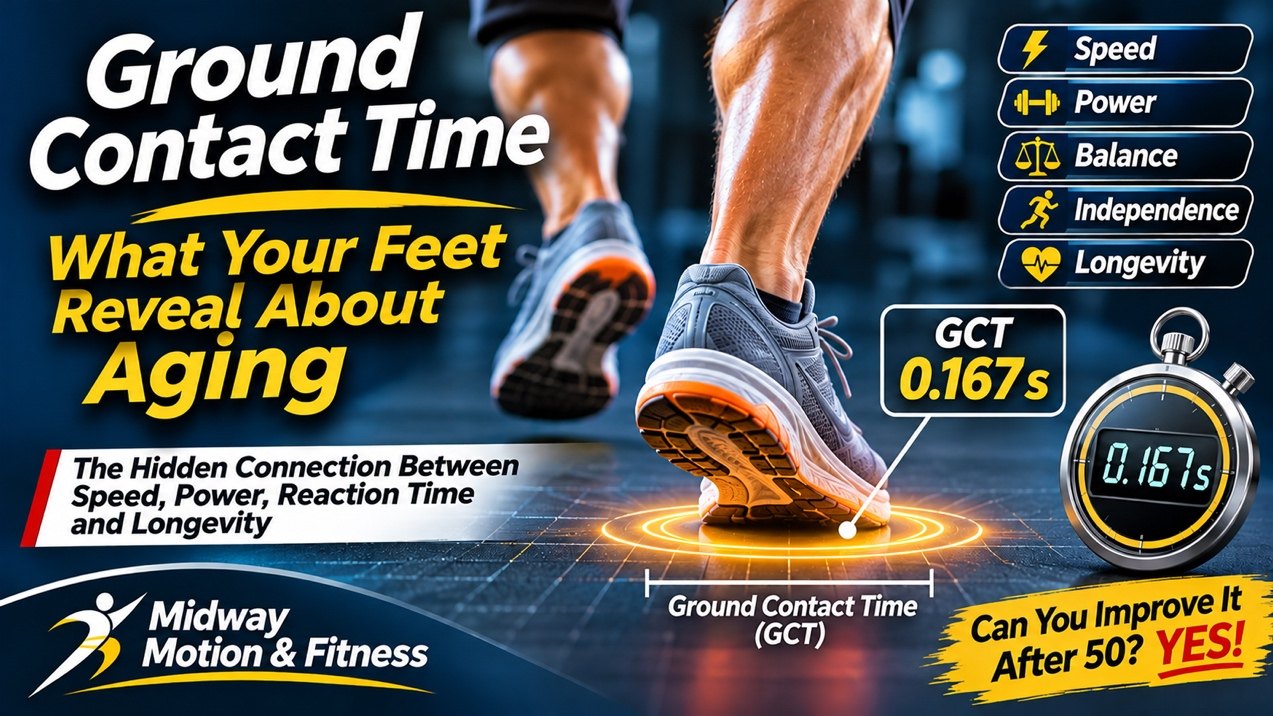
The hidden connection between speed, power, reaction time, and longevity.
When we think about aging, we often focus on losing muscle mass, strength, flexibility, or endurance. But another physical quality often declines with age and gets far less attention: our ability to produce force quickly.
Think about the last time you stumbled, stepped off a curb unexpectedly, or had to react quickly to avoid falling.
Your body didn't have several seconds to respond. It had a fraction of a second.
That ability to react, produce force, and reposition your body quickly is essential for maintaining balance, mobility, athletic performance, and independence as we age.
One interesting way to evaluate this ability is through a measurement called Ground Contact Time (GCT).
What Is Ground Contact Time?
Ground Contact Time is the amount of time your foot remains in contact with the ground during movements such as running, sprinting, hopping, or jumping.
It is typically measured in milliseconds (ms).
For example:
- 300 milliseconds = 0.30 seconds
- 200 milliseconds = 0.20 seconds
- 150 milliseconds = 0.15 seconds
Although these differences may seem small, they can be meaningful when evaluating how quickly an individual interacts with the ground.
During activities such as sprinting or repeated hopping, shorter ground contact times can indicate an ability to absorb and redirect forces rapidly.
However, shorter is not automatically better. Ground contact time must be interpreted alongside jump height, movement speed, technique, and the demands of the activity.
The goal isn't simply to get off the ground faster. It's to produce sufficient force in the limited time available.
Why Ground Contact Time Matters as We Age
As we get older, several changes can affect our ability to move quickly and efficiently.
These may include:
- Declining muscle power and rate of force development.
- Changes in fast-twitch muscle fiber size and function.
- Reduced tendon elasticity and changes in muscle-tendon stiffness.
- Slower or less coordinated neuromuscular responses.
- Reduced exposure to rapid, explosive movements.
One of the most important distinctions is that muscular power often declines earlier or more rapidly than maximal strength.
You might still have the strength to stand up from a chair, climb stairs, or perform a squat. But can you produce that force quickly when necessary?
That's a different physical ability.
Consider an older adult who unexpectedly loses balance while walking.
Having strong legs is important, but recovering balance also requires rapid muscle activation, coordination, and the ability to reposition the feet.
Ground contact time doesn't directly measure fall risk or reaction time, but it can provide useful information about rapid force production during specific athletic movements.
The Stretch-Shortening Cycle: Your Body's Natural Spring
To understand ground contact time, we need to understand how muscles and tendons work together.
Your muscles and tendons function somewhat like a spring.
When you land from a small hop, the muscle-tendon system absorbs energy as it lengthens under load.
If you immediately push off again, some of that stored elastic energy can contribute to the next movement.
This process is part of the stretch-shortening cycle (SSC).
It involves three phases:
1. Eccentric Phase — Absorbing Force
When your foot contacts the ground, the muscles and tendons help absorb the landing forces.
2. Amortization Phase — The Transition
This is the brief transition between absorbing force and producing the next movement.
3. Concentric Phase — Producing Force
The muscles generate force to propel your body upward or forward.
An effective stretch-shortening cycle allows the body to transition rapidly between these phases.
When this process becomes slower or less efficient, some movements may require more time on the ground.
This is one reason reactive strength and muscle-tendon function are important for athletic performance.
Your Feet and Ankles: The Foundation of Reactive Movement
Your feet and ankles play a major role in how you interact with the ground.
Every time you walk, run, jump, or change direction, your lower extremities must absorb forces, stabilize the body, and help propel you into the next movement.
The calf muscles, Achilles tendon, and structures within the foot are especially important during rapid hopping and running movements.
If these tissues lack sufficient strength, coordination, or appropriate stiffness, reactive movement performance may suffer.
But here's an important point: stiffness isn't necessarily bad.
In biomechanics, muscle-tendon stiffness refers to resistance to deformation under force, not simply the sensation of tight muscles.
An appropriately stiff muscle-tendon system can help transmit force and store and release elastic energy efficiently.
The objective is to develop the right combination of strength, mobility, elasticity, and control.
How Can We Measure Ground Contact Time?
Modern technology allows exercise professionals to evaluate ground contact time using force plates, contact mats, wearable sensors, and certain validated movement-analysis systems.
One simple assessment is a series of repeated pogo jumps.
During this test, an individual performs small, rhythmic jumps, attempting to minimize ground contact time while maintaining consistent jump height and controlled landings.
Two measurements are particularly useful:
Ground Contact Time (GCT): How long the feet remain on the ground.
Reactive Strength Index (RSI): A measure relating jump height to ground contact time.
For repeated jumps or drop jumps, RSI is commonly calculated as:
RSI = Jump Height (meters) ÷ Ground Contact Time (seconds)
For example, someone who jumps 0.25 meters with a ground contact time of 0.20 seconds would have an RSI of 1.25.
These measurements help evaluate reactive jumping performance and can be useful for monitoring changes over time.
However, results should be compared using consistent testing methods, jump instructions, equipment, and appropriate reference values.
Can You Improve Ground Contact Time After 50?
Absolutely. Many healthy older adults can improve aspects of rapid force production and reactive movement with appropriately progressed training.
The key is to begin with the individual's current strength, balance, joint health, and movement ability.
Not everyone needs to perform explosive jumps to benefit from faster, more intentional movement.
Here are several ways to develop the underlying physical qualities.
1. Calf Raises and Ankle Strengthening
Strong calf muscles are essential for walking, stair climbing, and propulsion.
Begin with controlled calf raises and progress toward faster concentric movements when appropriate.
2. Intentional Speed Training
Perform the lifting phase of selected resistance exercises with the intention of moving quickly while maintaining control.
For example, rise from a chair or perform a squat with a fast but controlled upward movement.
The actual speed may be modest, but the intention to accelerate challenges rapid force production.
3. Low-Level Pogo Jumps
For individuals with sufficient strength, balance, and tolerance for impact, small rhythmic jumps can help train the stretch-shortening cycle.
Focus on controlled, consistent contacts rather than simply jumping as fast as possible.
4. Quick-Stepping Drills
Practice rapid but controlled steps forward, backward, and laterally.
These exercises develop coordination and foot repositioning without requiring repeated jumping.
5. Strength and Power Training
Squats, step-ups, lunges, and other resistance exercises develop the muscular foundation needed for rapid movement.
Progressing toward faster movements under appropriate loads can further improve power.
Individuals with significant balance limitations, osteoporosis-related fracture concerns, recent injuries, or painful joints may need lower-impact alternatives and professional guidance before attempting jumping exercises.
Why This Matters Beyond Sports
People often talk about ground contact time in sprinting, jumping, and athletic performance.
But the underlying qualities of rapid force production, coordination, and muscle-tendon function also matter for everyday life.
Think about stepping over an obstacle, quickly changing direction, climbing stairs, or recovering from a stumble.
These activities depend on the body's ability to generate and control force within limited time.
A shorter ground contact time during a pogo jump does not guarantee better balance or prevent falls.
However, building the strength, power, and coordination that support reactive movement can help maintain physical function as we age.
This is why fitness programs for older adults should go beyond traditional slow resistance training.
Strength is essential, but so is the ability to use that strength quickly.
The Bottom Line: Train for Strength, but Don't Forget Speed
Aging doesn't mean we should stop moving quickly.
In fact, maintaining the ability to produce force rapidly may become increasingly important as we grow older.
Ground contact time provides one interesting window into how efficiently the body interacts with the ground during athletic movements.
It reminds us that physical performance isn't determined by strength alone.
We also need coordination, mobility, tendon function, reactive ability, and speed.
Because staying young isn't just about how much force you can produce. It's also about how quickly you can produce it when it matters.
Curious About Your Own Ground Contact Time?
Ever wondered how quickly your feet react to the ground?
Using specialized performance-testing equipment, Jason Kelly, Exercise Scientist, can measure your Ground Contact Time (GCT), Reactive Strength Index (RSI), and jumping performance.
These assessments provide valuable insights into your reactive strength, explosive power, and neuromuscular performance.
Interested in discovering your numbers?
Contact Jason Kelly to schedule a personal performance assessment and learn more about your body's ability to produce force quickly.
Jason Kelly